


喝咖啡与不喝咖啡,身体三个差距很明显!健康喝咖啡记住这几点There are three distinct differences between those who drink coffee and those who don't! Remember these points for healthy coffee consumption





Coffee, regarded by many as a "power tool" for refreshing the mind and preventing drowsiness, is even consumed by some people in the amount of 2-3 cups daily. Numerous studies have previously confirmed that drinking coffee indeed brings numerous health benefits.
Compared to those who never drink coffee, do these long-term coffee drinkers experience any physical changes? A recent study conducted by Harvard University found that coffee has a significant impact on the gut.
Photographed by Ren Xuan, Health Times
People who regularly drink coffee may experience significant changes in their gut microbiota!
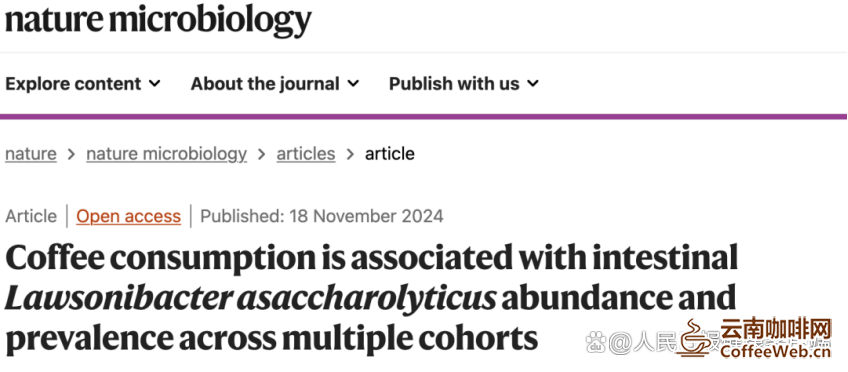
In November 2024, researchers from Harvard University published a study involving tens of thousands of people in the journal Nature Microbiology, revealing that regular coffee consumption can alter gut microbiota. Compared to those who never drink coffee (consuming less than three cups per month), individuals who consume three cups of coffee daily have levels of beneficial bacteria (L. asaccharolyticus) in their intestines that are 4.5-8 times higher! ①
Research screenshot
This study is the largest one to date investigating the association between human gut microbiota and coffee consumption. The researchers categorized over 22,000 participants into three groups based on their coffee intake:
Group 1: Never drink coffee (less than 3 cups per month)
Group 2: Drinking a large amount of coffee (more than 3 cups per day)
Group 3: Moderate coffee consumption (between never drinking and heavy consumption)
Research has found a close correlation between coffee intake and human gut microbiota, with coffee exhibiting the strongest association among over 150 types of foods.
Compared to those who never drink coffee, the level of beneficial bacteria (L. asaccharolyticus) is 4.5-8 times higher in those who consume a large amount of coffee. In those who drink coffee moderately, the level of beneficial bacteria (L. asaccharolyticus) is 3.4-6.4 times higher, and this difference is consistent across all global populations.
Coffee beans, photographed by Cao Zihao from Health Times
People who drink coffee regularly and those who never drink coffee,
The gaps in three aspects are quite evident
1. There may be significant differences in intestinal flora
As pointed out in the aforementioned study, coffee significantly enhances the levels of L. asaccharolyticus, with the most pronounced difference observed between non-coffee drinkers and coffee drinkers
People who regularly drink coffee have higher levels of L. asaccharolyticus, a beneficial gut bacteria. L. asaccharolyticus is a beneficial gut bacteria that helps the gut produce butyric acid, which helps maintain the intestinal barrier function and helps prevent enteritis and bowel cancer.
2. Low risk of facial skin aging
In 2024, a study published by researchers from Peking Union Medical College in the Journal of Cosmetic Dermatology found that regular coffee drinkers can effectively reduce the risk of facial skin aging.
Research screenshot
The study comprehensively analyzed the causal relationship between the consumption of four types of beverages—tea, coffee, alcoholic beverages, and sugary drinks—and facial skin aging. The research revealed that among the four beverages, only coffee effectively reduces the risk of facial skin aging, with coffee intake decreasing the probability of facial aging by 15%. The remaining three beverages did not show a clear association with facial skin aging
In other words, people who regularly consume coffee have a lower risk of facial skin aging and appear younger. A similar study published in the International Journal of Dermatology in 2014 found that coffee intake can effectively protect human skin from photoaging and reduce pigmentation. Researchers speculate that the beauty benefits of coffee lie in its polyphenols, such as chlorogenic acid.③
3. Lower risk of cardiovascular disease
A study published in the European Journal of Preventive Cardiology in 2022 found that drinking 0.5 to 3 cups of coffee per day was associated with a 12% reduction in all-cause mortality and a 17% reduction in cardiovascular disease mortality. ④
Research indicates that coffee contains various bioactive components, such as caffeine and polyphenolic compounds. Caffeine can stimulate the central nervous system, enhance alertness and attention, and may also exert a certain stimulatory effect on metabolism.
Polyphenolic compounds, on the other hand, possess antioxidant and anti-inflammatory properties, which help protect body cells from damage caused by free radicals, thereby maintaining the normal function of various organs in the body, especially the cardiovascular system.
Health Times picture
Drink coffee healthily, remember these 5 points
1. Don't drink coffee too hot
Whether it's coffee or other hot beverages, avoid drinking them too hot. In 2016, the International Agency for Research on Cancer (IARC) announced the carcinogenicity assessment results for overheated beverages such as coffee. Drinks with temperatures exceeding 65°C were classified as Group 2A carcinogens. This means that while the evidence for human carcinogenicity is limited, it is likely to cause cancer.
2. It's best not to drink more than 5 cups per day
It is recommended not to drink more than 5 cups of coffee per day. According to the "Scientific Consensus on Coffee and Health" jointly issued by the Institute for Nutrition and Health of the Chinese Center for Disease Control and Prevention in 2018, it is advisable for healthy adults to drink 3 to 5 cups per day (with a standard coffee cup capacity of 120 ml to 140 ml), which means consuming no more than 210 to 400 mg of caffeine per day.
3. Don't drink coffee too late
It is more appropriate to drink coffee after breakfast or lunch, as it can promote metabolism and aid digestion. Drinking coffee in the afternoon or evening may affect the quality of sleep at night.
Photographed by Wang Nan, Health Times
4. If you have a weak stomach, avoid drinking on an empty stomach
People with poor stomach health, especially those with underlying conditions such as chronic gastritis and gastroesophageal reflux, are advised not to drink coffee on an empty stomach.
5. Don't force drinking habits if you don't have them
Everyone has different physical conditions and lifestyle habits. Some people don't like to drink coffee, while others may experience urinary frequency, palpitations, and gastrointestinal discomfort after drinking coffee. If you don't have a habit of drinking coffee, there's no need to force yourself. You can still benefit from other healthy lifestyles.
This article is synthesized from:
①Manghi, P., Bhosle, A., Wang, K.et al.Coffee consumption is associated with intestinal Lawsonibacter asaccharolyticus abundance and prevalence across multiple cohorts. Nat Microbiol 9, 3120–3134 (2024). https://doi.org/10.1038/s41564-024-01858-9
②Liu X, Li X, Ma J. Beverage consumption and facial skin aging: Evidence from Mendelian randomization analysis. J Cosmet Dermatol. 2024 May;23(5):1800-1807. doi: 10.1111/jocd.16153. Epub 2024 Jan 4. PMID: 38178620.
③Fukushima Y, Takahashi Y, Hori Y, Kishimoto Y, Shiga K, Tanaka Y, Masunaga E, Tani M, Yokoyama M, Kondo K. Skin photoprotection and consumption of coffee and polyphenols in healthy middle-aged Japanese females. Int J Dermatol. 2015 Apr;54(4):410-8. doi: 10.1111/ijd.12399. Epub 2014 Jul 11. PMID: 25041334.
④Light to moderate coffee consumption is associated with lower risk of death: a UK Biobank study. European Journal of Preventive Cardiology, 20 January 2022